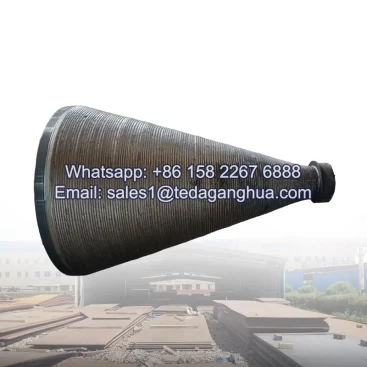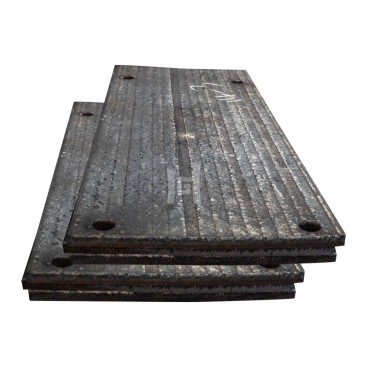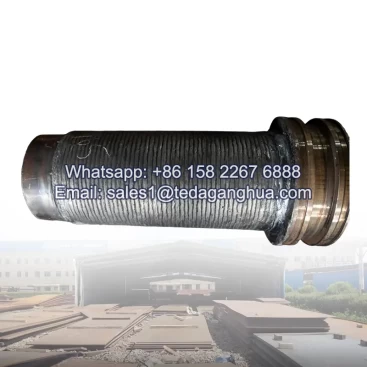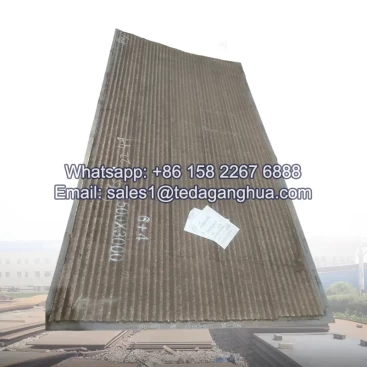


- Описание
Open Arc Hardfacing Plate: The Fast Deposition Self-Shielded Solution for Thick Overlay Applications
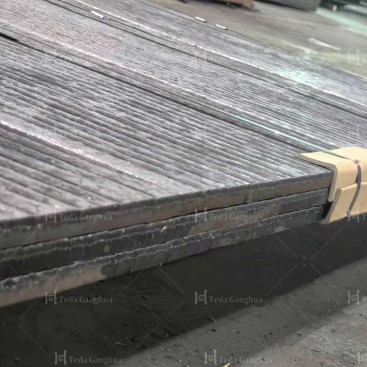
Open arc hardfacing has become an important welding technology for producing wear-resistant overlay plates where high deposition efficiency, flexible operation, and thick wear layers are required.
Unlike submerged arc welding systems that require flux coverage, open arc welding uses self-shielded flux-cored wires that generate their own protective shielding during the welding process. This eliminates the need for external shielding gas and flux recovery systems, making it highly suitable for large wear-resistant components and on-site repair applications.
This guide explains the working principle of open arc hardfacing, its advantages, limitations, and how it compares with SAW overlay technology.
1. What Is Open Arc Hardfacing?
Open arc hardfacing is an overlay welding process where a self-shielded flux-cored wire is melted by an electric arc directly in the atmosphere.
Во время сварки, the flux inside the wire produces shielding gases and slag protection, preventing excessive oxidation and stabilizing the weld pool.
The process does not require:
- External shielding gas supply
- Submerged flux coverage
- Flux recovery equipment
- Complex protection systems
This simplified setup provides excellent flexibility for industrial wear protection applications.
2. How Open Arc Welding Creates a Wear Layer
The open arc hardfacing process follows several key steps:
| Process Step | Основная функция |
|---|---|
| Wire feeding | Continuous supply of alloy-filled flux-cored wire |
| Arc generation | Creates heat to melt wire and substrate surface |
| Flux reaction | Generates protective shielding and slag coverage |
| Metal deposition | Forms chromium carbide wear-resistant overlay |
| Cooling and slag removal | Reveals the finished wear surface |
3. Key Advantages of Open Arc Hardfacing
3.1 High Deposition Efficiency
Open arc systems provide high melting efficiency, making them suitable for applications requiring thick overlay layers.
Typical advantages include:
- Fast deposition speed
- Reduced production time
- Suitable for thick overlay structures
- Lower labor requirements compared with manual welding
3.2 No Flux Recovery System Required
Because self-shielded wires generate their own protection, manufacturers avoid the additional equipment required for submerged arc welding.
This reduces:
- Equipment investment
- Flux handling costs
- Cleaning operations
- Production complexity
3.3 Excellent Field Repair Capability
Open arc welding is highly suitable for maintenance environments where equipment cannot easily be transported back to a factory.
Типичные области применения включают в себя:
- Mining equipment repair
- Crusher component restoration
- Large hopper repair
- Heavy machinery wear protection
4. Applications for Open Arc Hardfacing Plate
Open arc overlay technology is commonly selected for:
| Приложение | Why Open Arc Is Suitable |
|---|---|
| Thick overlay plates | High deposition efficiency for layers above 6mm |
| Горнодобывающее оборудование | Fast production and strong abrasion resistance |
| Large structural parts | Flexible welding position capability |
| On-site repair | No external gas or flux equipment required |
| Complex geometry components | Better adaptability than fixed welding systems |
5. Open Arc vs SAW Hardfacing Technology
Both open arc and submerged arc welding are widely used for chromium carbide overlay production, but each technology has different performance characteristics.
| Performance Factor | Наплавка открытой дугой | SAW Hardfacing |
|---|---|---|
| Deposition speed | Очень высокий, especially for thick overlays | High and stable for large flat plates |
| Flux requirement | No external flux required | Requires flux coverage and recovery |
| Dilution control | Moderate variation depending on parameters | Generally more stable control |
| Surface flatness | Хороший, but more visible welding texture | Excellent surface uniformity |
| Hardness consistency | Stable with optimized parameters | Very consistent for production batches |
| Application flexibility | Excellent for repair and irregular shapes | Best for factory large-area production |
6. Dilution Rate and Wear Performance
Dilution control directly affects the final wear resistance of a hardfacing plate.
A lower dilution rate helps maintain:
- Higher chromium carbide concentration
- Improved surface hardness
- Longer abrasion resistance life
- More stable wear performance
Open arc welding can achieve excellent wear performance when welding current, voltage, travel speed, and wire composition are properly controlled.
7. Open Arc Welding Quality Control
Professional production requires strict control of:
| Control Item | Цель |
|---|---|
| Wire chemistry | Ensure correct carbide formation |
| Welding parameters | Control penetration and dilution |
| Толщина наложения | Maintain designed wear life |
| Проверка твердости | Confirm wear resistance level |
| Surface inspection | Detect cracks and defects |
8. Open Arc Hardfacing Plate Solutions from Teda Ganghua
Teda Ganghua supplies chromium carbide overlay plates manufactured for severe abrasion environments including mining, цемент, сталь, и тяжелая промышленность.
Our solutions include:
- Advanced open arc hardfacing technology
- Customized overlay thickness options
- Large-size wear plate production
- CNC cutting and fabrication services
- Application-based wear material recommendations
By combining advanced welding technology with strict quality management, Teda Ganghua helps customers reduce downtime and extend equipment service intervals.
Learn more:
Заключение
Open arc hardfacing provides a fast, гибкий, and cost-effective solution for thick overlay applications. Its high deposition rate, simple equipment requirements, and excellent repair capability make it ideal for demanding industrial wear environments.
For large-scale factory production requiring maximum surface consistency, SAW remains a preferred option. For thick overlays, field repair, and complex components, open arc hardfacing offers unmatched flexibility and efficiency.