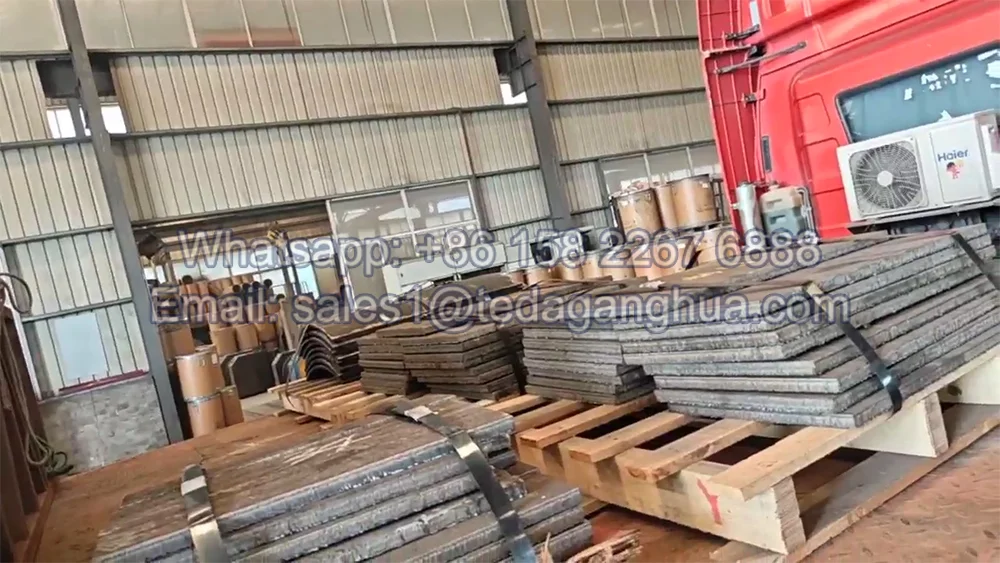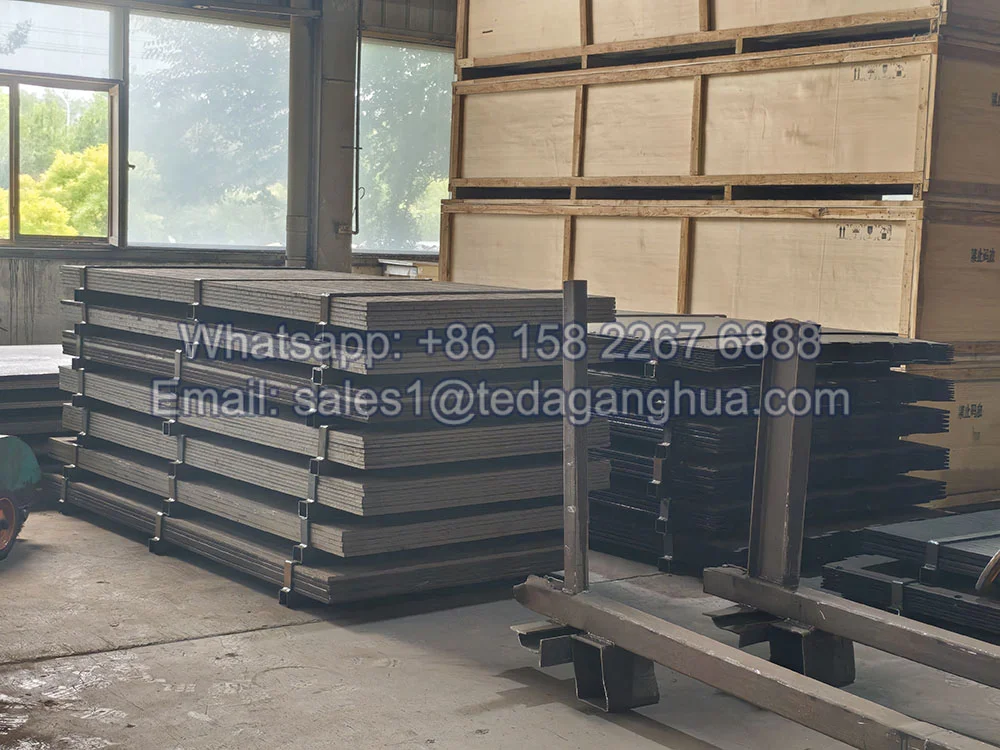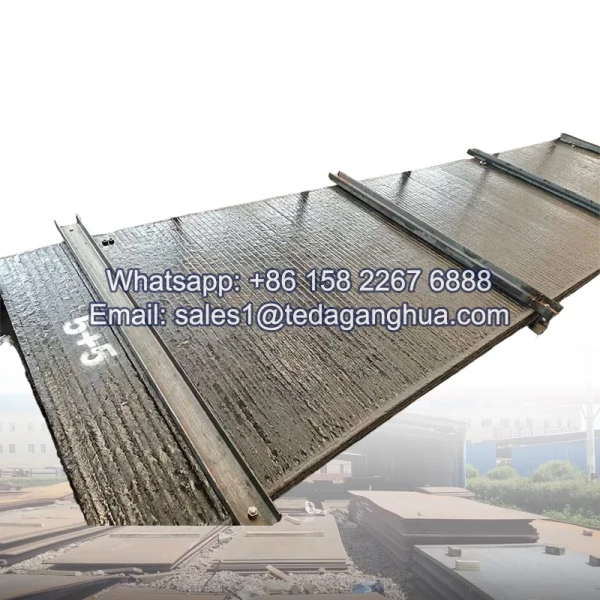

- Description
Arc Welded Overlay Plate Manufacturing: From Bare Steel Plate to Finished Wear-Resistant Product
The performance of a wear-resistant overlay plate depends on more than the alloy composition. A stable manufacturing process is essential to achieve strong bonding, uniform hardness, controlled dilution, and long service life.
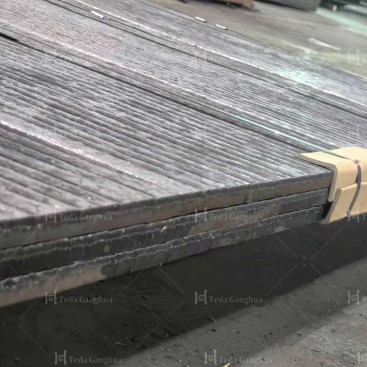
Arc welded overlay plate manufacturing transforms a standard steel backing plate into a high-performance wear protection product through surface preparation, controlled welding, heat management, finishing, and quality inspection.
This complete process guide explains how chromium carbide overlay plates are produced, the critical control points at each stage, and how manufacturers prevent common welding defects.
1. Complete Manufacturing Process Overview
A typical arc welded overlay plate production line includes the following stages:
| Manufacturing Stage | Main Purpose |
|---|---|
| Base plate preparation | Remove contamination and create suitable welding conditions |
| Preheating | Control thermal stress and reduce cracking risk |
| Welding wire or strip selection | Determine alloy chemistry and wear performance |
| Automatic arc welding | Create the wear-resistant overlay layer |
| Slow cooling | Reduce residual stress and prevent crack propagation |
| Leveling and cutting | Achieve required flatness and dimensions |
| Final inspection | Verify hardness, bonding, and surface quality |
2. Base Steel Plate Preparation
The first step determines the quality of the final bonding interface. Before welding, the steel substrate must be properly cleaned and prepared.
2.1 Surface Cleaning and Blasting
Shot blasting or sand blasting removes:
- Rust and oxide layers
- Oil contamination
- Surface impurities
- Loose scale
A clean surface improves arc stability and ensures stronger metallurgical bonding between the overlay and base steel.
2.2 Preheating Process
Depending on substrate thickness and alloy composition, preheating is commonly controlled within approximately 150-250°C.
Benefits of preheating include:
- Lower cooling speed
- Reduced thermal shock
- Improved weld penetration stability
- Lower risk of hydrogen-induced cracking
3. Welding Material Selection
The welding consumable determines the chemical composition and wear performance of the overlay layer.
| Material Type | Main Feature |
|---|---|
| Chromium carbide wire | High abrasion resistance and stable hardness |
| Flux-cored wire | Flexible alloy adjustment and efficient deposition |
| Wear-resistant strip electrode | High deposition efficiency for large-area plates |
The selected alloy system affects:
- Carbide volume fraction
- Hardness level
- Impact resistance
- High-temperature wear performance
4. Automatic Arc Welding Process
Modern overlay plates are mainly produced using automated welding equipment to achieve consistent quality over large surfaces.
4.1 Single Wire Welding
Single wire systems are suitable for general wear plate production where controlled deposition speed and flexibility are required.
4.2 Multi-Wire Welding
Multi-wire welding increases productivity by improving deposition efficiency.
- Higher production speed
- More stable layer thickness
- Suitable for large-format plates
4.3 Strip Overlay Welding
Strip welding provides a wider deposition area and excellent surface uniformity, making it suitable for industrial wear plates requiring consistent performance.
5. Welding Quality Control Parameters
During automatic welding, manufacturers control several key parameters:
| Parameter | Influence on Product Quality |
|---|---|
| Welding current | Controls heat input and deposition rate |
| Arc voltage | Affects bead shape and penetration |
| Travel speed | Controls overlay thickness and dilution |
| Heat input | Determines thermal stress and microstructure |
6. Common Welding Defects and Solutions
| Defect | Main Cause | Prevention Method |
|---|---|---|
| Cracking | Excessive cooling rate, high thermal stress, improper preheating | Optimize preheating and cooling procedures |
| Porosity | Moisture, contamination, unstable shielding conditions | Improve surface cleaning and welding control |
| Slag inclusion | Improper welding speed or insufficient cleaning | Optimize welding parameters and remove slag between passes |
| High dilution rate | Excessive penetration into base steel | Adjust current, voltage, and travel speed |
7. Post-Welding Cooling and Stress Control
After welding, controlled cooling is required because overlay plates contain different materials with different thermal expansion characteristics.
Slow cooling helps:
- Reduce residual stress
- Improve crack resistance
- Maintain bonding integrity
- Stabilize the wear layer structure
8. Leveling, Cutting, and Final Processing
After cooling, the overlay plate enters finishing operations:
- Plate leveling
- CNC cutting
- Dimension adjustment
- Edge preparation
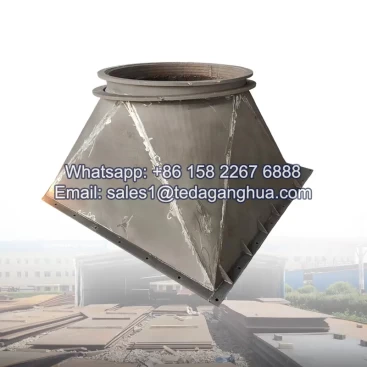
- Custom fabrication
These processes ensure the final product meets customer requirements for installation and fabrication.
9. Final Inspection Before Shipment
A professional quality inspection system evaluates:
| Inspection Item | Purpose |
|---|---|
| Hardness testing | Verify wear resistance performance |
| Thickness measurement | Confirm overlay layer consistency |
| Visual inspection | Identify surface defects |
| Metallographic examination | Check bonding structure and carbide distribution |
10. Arc Welded Overlay Plate Solutions from Teda Ganghua
Teda Ganghua provides chromium carbide overlay plate solutions manufactured for demanding industrial wear applications.
Our production capabilities include:
- Automatic arc welded overlay technology
- Customized wear layer thickness
- Large-size wear plate production
- CNC cutting and fabrication services
- Application-based material recommendations
With strict process control from substrate preparation to final inspection, Teda Ganghua helps customers reduce equipment downtime, extend replacement cycles, and improve total operating efficiency.
Learn more:
Chromium Carbide Overlay Plate
Conclusion
Arc welded overlay plate manufacturing is a complete engineering process where every stage affects final performance. Proper surface preparation, controlled welding parameters, and rigorous inspection are essential for producing reliable wear-resistant plates.
For mining, cement, steel, and heavy industrial applications, high-quality chromium carbide overlay plates provide a durable solution against severe abrasion and impact wear.