High Manganese Steel vs Chromium Carbide Overlay Plate for Scrap Grapple Cutting Edges
Scrap Recycling Industry: Should Grapple Cutting Edges Use High Manganese Steel or Chromium Carbide Overlay Plate?
In the scrap recycling industry, grapple cutting edges are subjected to continuous impact, sliding abrasion, and metal-to-metal contact. Choosing the wrong wear material can result in frequent maintenance, reduced productivity, and increased operating costs. Two of the most common material options are high manganese steel (Mn13) and chromium carbide overlay (CCO) wear plate. Each material performs differently depending on the operating conditions.
This guide compares their wear mechanisms, impact resistance, service life, and application suitability to help equipment manufacturers and recycling operators make the right decision.
1. Material Characteristics Comparison
| Property | High Manganese Steel (Mn13) | Chromium Carbide Overlay Plate |
|---|---|---|
| Main wear mechanism | Work hardening under impact | Extremely hard chromium carbide layer resists abrasion |
| Surface hardness | HB 200–250 (before work hardening) | HRC 58–65 |
| Impact resistance | Excellent | Moderate to high (depends on overlay design) |
| Abrasion resistance | Good under heavy impact | Outstanding under sliding abrasion |
2. Working Principle: Different Wear Mechanisms
High manganese steel becomes harder as it experiences repeated impact. During operation, its surface gradually work-hardens while maintaining a tough core, making it ideal for severe impact applications.
Chromium carbide overlay plate relies on a dense network of chromium carbides embedded in a welded alloy layer. These carbides provide exceptional resistance to abrasive wear even without repeated impact.
3. Which Material Fits Different Scrap Types?
| Scrap Material | Recommended Material | Reason |
|---|---|---|
| Heavy structural steel | High manganese steel | High impact loading activates work hardening |
| Mixed scrap with dirt and sand | Overlay plate | Excellent resistance to abrasive particles |
| Automobile scrap | Overlay plate | Longer edge life under continuous abrasion |
| Demolition scrap | Combination design | Impact and abrasion occur simultaneously |
4. Service Life Comparison
| Operating Condition | High Manganese Steel | Overlay Plate |
|---|---|---|
| High impact | Excellent | Good |
| Continuous sliding wear | Moderate | Excellent |
| Mixed impact + abrasion | Good | Very good |
| Maintenance interval | Medium | Long |
For many modern scrap yards, overlay plates significantly extend maintenance intervals because abrasive wear is often the dominant failure mode.
5. Hybrid Design: The Best of Both Materials
Many equipment manufacturers now combine both materials in one grapple:
| Component | Recommended Material |
|---|---|
| Main structural frame | High-strength structural steel |
| Impact zones | High manganese steel |
| Cutting edges | Chromium carbide overlay plate |
| High-wear liners | Overlay plate or NM400 wear plate |
This hybrid solution balances toughness, wear resistance, and overall lifecycle cost.
6. Selection Decision Guide
| If Your Primary Challenge Is… | Recommended Material |
|---|---|
| Heavy impact loads | High manganese steel |
| Severe abrasive wear | Chromium carbide overlay plate |
| Balanced impact and abrasion | Hybrid solution |
| Long maintenance intervals | Overlay plate |
7. Why Buyers Choose Teda Ganghua
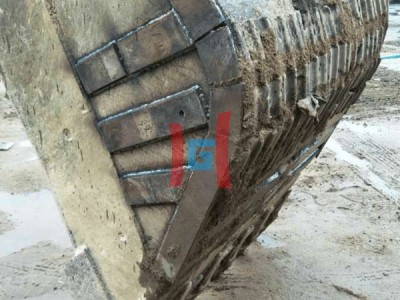
At Teda Ganghua, we supply high-performance wear-resistant materials for the recycling, mining, cement, and heavy equipment industries. Our product range includes NM400 wear-resistant steel plates, chromium carbide overlay plates, and customized wear solutions for grapples, buckets, chutes, crushers, and recycling equipment.
We provide CNC cutting, custom fabrication, wear component design support, and export packaging to help customers reduce downtime and improve equipment productivity.
Explore our wear-resistant steel products here:
NM400 Wear Resistant Steel Plate
Conclusion
Neither high manganese steel nor chromium carbide overlay plate is universally better. High manganese steel excels under severe impact loading, while overlay plates deliver outstanding abrasion resistance and longer service life in sliding wear environments. Understanding the dominant wear mechanism is the key to selecting the most cost-effective solution for scrap recycling equipment.